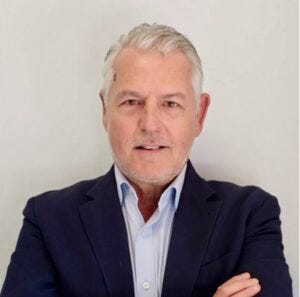
A Conversation with Rémi Burdairon
Stablecoins, Tokenisation, Blockchain and Trade Finance

Within the next five years, all international deals for commodity trading will run on stablecoins. - Tether CEO, Paolo Ardoino
Good morning, Remi. Please tell me about yourself.
I’m French but was born in Senegal, West Africa. I spent part of my youth in East Africa, in Djibouti and Ethiopia, and the rest of my early life mainly in France. I have spent the past 25 years in South Africa. I’m married; my wife is English, and we have three boys.
After graduating from the French business school ESSEC, I began my career in 1985 in London, working in the financial markets, with a focus on swaps, options, and Treasury bonds. My ambition was to move into commodities, so when I had the chance to join Dreyfus in Paris in 1987, I seized it. I worked there for four years but decided the grass was greener elsewhere, so I left Dreyfus for a few years. They invited me back in 1994 to join their team in Madrid, where I was head of trading for Spain and Portugal. In 1998, Dreyfus transferred me to Johannesburg, South Africa, as an expatriate. I enjoyed the experience and chose to stay.
I spent ten years in Johannesburg, expanding the business from a small venture to over 50 staff and multiple offices. We traded mainly agricultural commodities with a regional focus.
In 2008, I decided to leave Dreyfus and return to Europe for family reasons. South Africa was not the best place at that time to educate three boys. I moved back to Europe, specifically to Barcelona, where I managed several food security initiatives with Morgan Stanley, as well as biotechnology projects.
And very quickly, Africa called me back. By 2011, I was back in Johannesburg, working for Ameropa and setting up a grain and fertiliser operation. In 2013, I joined my former colleagues from Dreyfus to establish a new venture, Englehart Commodities, under BTG Pactual Investment Bank’s management. It was an interesting experience.
I’ve loved commodity trading all my life, but over the past decade I’ve seen margins gradually shrink as the market has become more transparent.
It became increasingly difficult to make money: the FOB seller would sell C&F, and the C&F buyer would buy FOB. The way traders operated was being challenged, and it was becoming more necessary to take a flat price position and incorporate it into a physical portfolio to gain a market edge.
In 2017, while I was still with BTG Pactual, I attended a conference in Tanzania, where I met one of the largest wheat importers. I asked whether he was buying wheat. He told me to join the queue behind Cargill, ADM, and everyone else. However, when I mentioned I had finance, he immediately asked me to come to his office the next day. I suddenly realised I had possibly been trading the wrong commodity for the previous 20 years. Finance was the most in-demand commodity in Africa.
I shifted to trade finance and joined the Barak Fund, then the largest trade finance fund in Africa, which at its peak managed $1.3 billion in assets. I managed one of their smaller funds, combining traditional short-term credit and profit sharing with traders. I left them in 2023 after a restructuring of the fund. Still, I continued working in African finance, operating at the intersection of trade finance and commodity trading, with a strong interest in new technology and digitalisation.
You recently spoke at two conferences in South Africa, where you estimated the funding gap for small and medium-sized trading firms at around $200 billion. How did you arrive at that figure?
The African Development Bank and associated studies estimate Africa’s trade finance gap before COVID at around USD 80-120 billion annually, although it has expanded over the past decade. More recent figures cited by AfDB mention a gap of over $120 billion each year. I believe it exceeds that. I receive several requests each week for credit and short-term finance in Africa.
Why does that gap exist?
Banks are generally risk-averse and often lack the technical expertise and appetite to structure smaller transactions. They tend to focus on larger deals because the time spent remains the same whether financing a $5 million or a $50 million deal. From a purely asset- and resource-allocation perspective, banks rarely consider anything below a $10 million ticket size.
That’s where a prime opportunity exists for private credit and private funds. Currently, about a dozen funds operate in Africa, mostly managed from Geneva, London, or Dubai. Few operate directly on the ground.
You must realise that in Africa, appearances can be misleading. It presents a challenge for banks or traditional institutions. This is where trade finance can be effective: you don’t finance the balance sheet; you finance the asset. However, Africa’s logistics and value chains can be problematic. If you asked me today whether I could finance copper for a third party in the DRC or Zambia, I would say no. It’s too risky. Too little control, too much fraud.
Promoters of stablecoins argue they can be useful when US dollars are scarce in these countries. I find that difficult to understand because you need dollars to initially purchase stablecoins.
You don’t always need dollars; you can use local currency to acquire stablecoins through exchanges or OTC desks. Stablecoin operators can establish a liquidity pool and must comply with local regulations. What stablecoins actually address is not dollar scarcity itself, but the inefficiency of dollar distribution and reuse. By enabling instant, borderless settlement, the same pool of dollar liquidity can circulate more quickly and support far more transactions than in traditional banking systems.
But that’s not the main reason for their interest. The value of stablecoins lies in their transparency, speed, and low cost.
Can they avoid forex controls?
No, but liquidity providers, exchanges, and OTC desks must supply the necessary documents for exchange control purposes. Stablecoins don’t eliminate foreign-exchange controls, but by transferring money outside the banking system, they make these controls harder to enforce; they shift enforcement from transaction-level to access-point controls.
Even so, are you bullish on stablecoins?
Yes, very much so. Tether’s CEO has predicted that within the next five years, all international commodity trading deals will be conducted using stablecoin. Commodity trading faces issues with cash flow, trust, and timing. Stablecoins address all three: quick settlement, global liquidity, and no downtime. For anyone involved in commodities who is tired of paperwork and payment delays, this will be a significant relief.
Today, traditional finance and payment channels (TradFi) are increasingly struggling to fulfil this role.
How might things evolve?
It will be driven from the bottom up, starting with on-the-ground operators. I already have clients operating in stablecoins, some to avoid dollar payments passing through American banks.
If you’re a trader in the Ivory Coast or Morocco and want to make or receive a payment, or receive a USD payment, you might be concerned that your funds will need to be cleared by the corresponding bank in the US. There is a move to diversify away from the US dollar, which has become increasingly problematic and risky for certain operators. Even if they are fully compliant and do nothing wrong, they still want to avoid the risk.
DeFi will present a major challenge for banks, leading to revenue loss.
Which countries in Africa would be your initial targets: West African cocoa or East African coffee?
It will be a country where the concept of stablecoins is already accepted, a digitally friendly and educated nation, such as Kenya, South Africa, or perhaps Rwanda. Nigeria is already experienced with crypto and digital assets, although the transactional side remains somewhat challenging.
I am collaborating with a small group of partners to launch a venture that will pilot a new transaction model with the potential to transform commodity trading in Africa.
To clarify, stablecoins don’t mean you can skip daily risk management tasks; you still need to address counterparty liquidity, regulatory risk, and all of that.
Yes, there are still reputational risks and KYC and AML requirements you must meet. Stablecoin itself is not without risk. Tether, the world’s largest US stablecoin holder, was recently downgraded by S&P. Circle, the second-largest stablecoin by USD-denominated market capitalisation, is better aligned with US regulations and could be the first choice for risk-sensitive investors. However, it is not as liquid.
Is there a regulatory risk that a new US administration will close them down?
I don’t think so. If it isn’t USDT or USDC, it will be someone else. It’s not a process that will be stopped, especially after the GENIUS Act, enacted in July 2025, which created the first clear U.S. regulatory framework for payment stablecoins.
Now, let us move on to tokenisation. What is it, and how does it work?
A year ago, I discovered an interesting initiative by a fintech company in Mumbai. I contacted the CEO and realised the company had built one of the largest commodity tokenisation platforms in the world. It utilises blockchain technology and has tokenised over $800 million worth of farm commodities.
This company operates a warehouse receipt financing system in which farmers receive digital, tokenised warehouse receipts recorded on the blockchain that serve as secure collateral for loans. Farmers can trade, refinance, or sell their tokenised receipts through an integrated marketplace.
The platform currently operates in approximately 1,500 warehouses across five states. It has disbursed over $25 million in digital loans to more than 70,000 smallholder farmers. It is a remarkable initiative, recognised by the Bill & Melinda Gates Foundation as unique.
I went to India, saw what they had done, and said, “We have to do that in Africa.” The CEO and I travelled together to Kenya, where we will soon launch a similar initiative.
Why are tokens better than paper warehouse receipts?
Firstly, there is no risk of forgery.
Second, farmers can trade or cash in their tokens in parts. When you deliver 100 tonnes of cocoa to a warehouse, you receive 100 tokens. Tokenisation, combined with stablecoins and blockchain technology, allows cocoa in the warehouse to be sold to investors in separate lots. The large US banks are doing the same with the fractionalisation of Treasury bonds and bills, enabling smaller investors to take part in the market.
We will reach a point in Africa where individual farmers are financed for 25 kilos, 25 tonnes, or whatever, and individual investors provide funding for these farmers for $25 or $250.
It’s a revolution. The challenge we face today in private credit is that impact finance, which everyone discusses at ESG conferences, is hard to implement. The reporting required for it is overwhelming. We will see a new structure emerge in which trade finance becomes more accessible.
Isn’t it a sort of micro-financing?
I call it macro finance with digital tools.
You’ve heard of the tokenisation of real-world assets, or RWA. Today, you can tokenise existing goods, but what about tokenising a crop that hasn’t been planted yet? Then you can also tokenise a person’s behaviour.
This is already happening in India, where everyone has an online ID. It is straightforward to identify individuals and assign a credit or performance rating. For instance, you could identify a particular farmer who has performed exceptionally well over the past two or three seasons, add this achievement to their credit score, and tokenise it.
When I interviewed Saurabh Goyal, he told me that blockchain works with Bitcoins but not with physical commodities. Am I correct in thinking that tokenisation is the missing link, enabling commodities to be traded easily on a blockchain platform?
Yes, definitely, yes.
However, remember that this is a digital twin of a real-world asset, so whatever is traded must ultimately be returned to the physical commodity. That remains the weakest part of the process.
Let’s examine financing cocoa exports from West Africa. Instead of a conventional warehouse receipt overseen by a collateral manager, someone issues tokens, and I convince financiers or traders that they are as dependable as the actual goods. The goods must be physically present. There is a risk of a disconnect between the digital record and the real-world asset. This aspect must be carefully considered and properly managed.
In other words, you issue the token for the goods in the warehouse, but the goods disappear.
Exactly.
Will that be the most complex challenge in Africa?
Yes.
The second challenge will be acceptability. People in Africa are very traditional. However, everyone was surprised by the explosion in mobile phone use. We expected Africa to be ten years behind. You’ve heard of M-Pesa, the East African mobile payment system widely regarded as one of the most important developments of its time. I am confident that Africa will quickly embrace Blockchain and tokenisation.
The third challenge is obtaining regulatory approval for digital assets. Some countries now permit it, and it will become more widespread. I have no doubt about that.
The fourth is a notable client risk because you have many small and medium-sized traders.
What about the big operators? Are the ABCD++ group of companies moving into tokenisation and stablecoins, or are they resisting?
I don’t think that the leading traders are particularly interested. They have experimented with blockchain and set up Covantis, a joint initiative to rationalise and digitise documents on a shared platform. They employ a whole team of execution staff in their shared back office in Geneva to handle paper bills of lading and certificates of origin.
In attempting to digitise the industry, I believe they have chosen the wrong approach. They require a simpler, more adaptable solution. Stablecoin is one such option because it does not handle the entire transaction process; it merely facilitates payments. When it comes to payments, there are two risk factors: payment risk and market risk. You can use a stablecoin for both guarantees and payments.
However, I anticipate that large companies will be hesitant to adopt stablecoins and tokenisation initially, although they might do so indirectly through infrastructure or financing divisions rather than through front-office trading. It will be driven by the base, not the top. It will be a bottom-up, rather than a top-down, phenomenon.
What about Tether’s entry into trade finance? Is it a revolution? Will it transform the African commodity trade?
Tether has announced plans to deploy $1.5 billion in trade finance. I haven’t seen any evidence of this in practice. They’ve completed a few transactions, but they are already several months old.
Would it be a revolution? I’m unsure, but it would certainly represent a radical disruption for established private credit stakeholders. Currently, the largest credit fund in Africa deploys a few hundred million dollars, compared to Tether’s $1.5 billion.
The company has a greater interest in LATAM, a powerhouse in commodities. If you want to gain traction and grow quickly, that is where I would start. Africa should be next, given that traditional banking infrastructure is limited and transaction costs are high.
The strongest foundation for a trade finance empire is ownership of physical assets used to move goods. Think of DP World or Maersk. They can be more confident in trade finance because they control the goods. When you have control over the goods, you don’t require a collateral manager to reduce the risk. If, six months from now, you tell me that Tether has acquired ports or a global network of warehouses, it would make a lot of sense.
Okay, I hadn’t considered that, but it makes sense. It’s much safer to tokenise and digitalise if you control the physical commodity and own the infrastructure. Is that the key?
It is the key. There are two ways to use collateral: either you control it, or you own it. Control is only that good, you know? Shit can happen. Owning it gives you ultimate security.
It also gives you leverage. Imagine you own a 300,000-tonne port silo. Someone delivers 25,000 tonnes to the silo to supply a vessel arriving in two weeks, but the ship is delayed. Do you think the same 25,000 tonnes will remain in the silo until the ship arrives, or will it be delivered to another vessel? Someone else will use the 25,000 tonnes. Suddenly, you have the leverage for trading.
Anything to add?
I’ve attended a few recent crypto conferences, and many traditional Bitcoin holders might be interested in exploring alternative investment options. The same balance sheets that supported exchanges and DeFi are shifting toward the real economy and are now looking at opportunities in commodities, storage, and shipping. The boundary between digital finance and physical trade is rapidly vanishing.
We are on the verge of a revolution in commodity transactions and trading, along with a surge of funding from the crypto sphere. Traditional finance is reaching a breaking point, and the combined power of stablecoins and tokenisation is poised to fundamentally change how commodities are financed, traded, and settled worldwide.
Thank you, Remi, for your time and input.
© Commodity Conversations®2026
This is a thoughtful discussion of payment friction and trade-finance gaps, but it quietly conflates three analytically distinct layers: settlement rails, regulatory arbitrage, and credit creation.
Stablecoins are plausibly useful as payment infrastructure — faster settlement and higher dollar velocity are real advantages. That claim stands on its own.
Where the argument weakens is when this payment efficiency is implicitly extended into regulatory bypass and then further into systemic credit expansion via tokenisation. FX controls, AML/KYC, and capital enforcement do not disappear; they relocate to on-/off-ramps and to custody. Likewise, tokenised warehouse receipts do not create trust — they merely digitise it, and only to the extent that physical control, inspection, and legal enforceability already exist.
The interview actually acknowledges the core constraint: the weakest link is the physical-digital boundary. That admission undercuts any near-term “revolution” narrative. Without ownership or hard control of storage, logistics, and ports, tokenisation scales risk as efficiently as it scales liquidity.
In that sense, the likely outcome is not disintermediation of institutions, but re-intermediation around those who already control infrastructure. Technology changes the rails, not the hierarchy.
The weak point Rémi identifies - the disconnect between digital record and physical assets - is where most of this will live or die. Tokenized warehouse receipts sound elegant until you’ve seen the operational reality of collateral management across multiple jurisdictions with different legal frameworks, inspection standards, and enforcement mechanisms. The question isn’t whether the technology works. It’s whether the trust infrastructure around the physical can keep pace. From inside a major trader, I’d say we’re further from that than the crypto funding enthusiasm suggests.